Why “Perfect” Dubbed Anime Voice Can Be a Red Flag
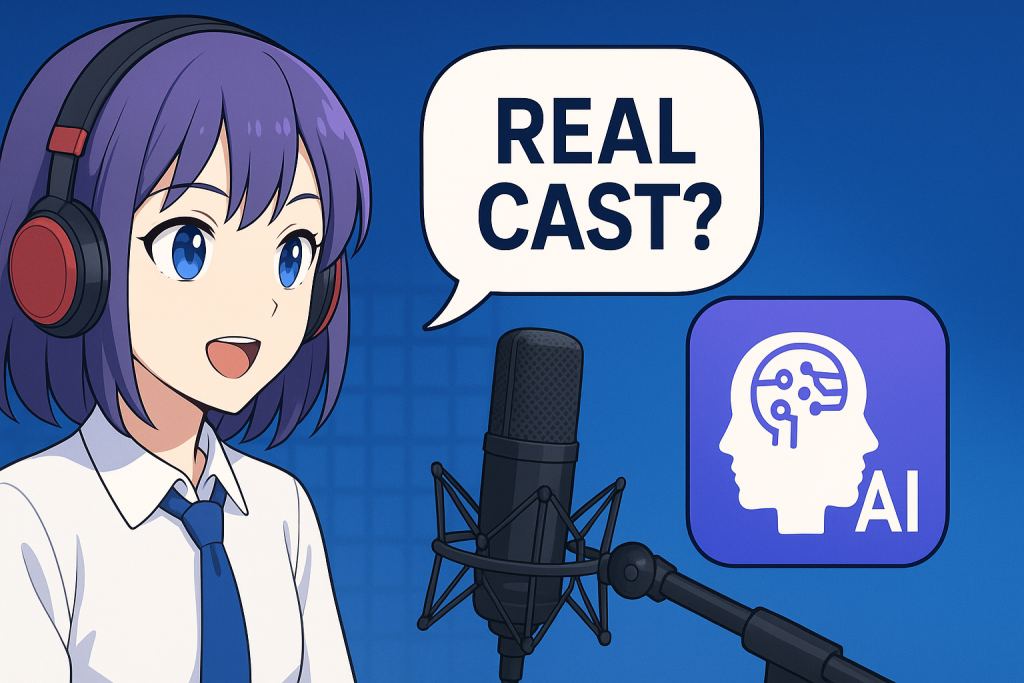
When a dubbed scene lands with uncanny calm-every line hitting the same emotional temperature, every pause feeling engineered-it can trigger a simple question: is this AI voice in anime, or is it a real cast performance?
As a fan who also reviews audio quality for accessibility and localization, I look for patterns that human voice actors naturally produce and AI systems often struggle to reproduce consistently. The goal isn’t to accuse anyone; it’s to spot dubbed anime voice authenticity using repeatable signals.
What “Too Perfect” Usually Means in Practice
In real dubbing, performances are polished, but they still show micro-variation: breath timing, slight consonant roughness, and prosody that shifts with context. AI voice systems often sound clean in a way that feels uniform across characters and scenes.
Common “too perfect” cues show up as prosody mismatch (rhythm and emphasis don’t match the emotion or the original timing), or as subtle timing drift that shows up when you compare the picture to the audio.
Real Cast vs AI Voice: The Signals You Can Actually Check
Use these checks as a layered approach. One clue can be noise; a cluster of clues is evidence. I recommend you verify with both audio-only listening and a quick picture-audio comparison.
1) Lip-Sync vs Audio Alignment
Start with a simple playback loop: watch a character’s mouth movement and then listen to consonants and vowel starts. Humans naturally align speech with mouth motion, even when the dub is adapted for timing.
AI voice systems frequently show lip-sync vs audio alignment issues. You may notice that the mouth closes on one beat while the voice’s onset lands slightly earlier or later, especially on plosive sounds like “p,” “b,” “t,” and “k.”
- Look for repeated offsets across multiple lines, not just one.
- Pay attention to fast exchanges where timing pressure is highest.
- Check scenes with mouth shapes that stay stable (e.g., held vowels) to spot drift.
2) Phoneme Timing Errors
Next, focus on how the voice handles the edges of words. Real voice acting includes tiny timing irregularities: a consonant might be fractionally late when the actor takes a breath, or a vowel might stretch naturally for emphasis.
AI systems often produce phoneme timing errors that are easy to miss at normal speed but obvious when you slow playback. You might hear consonants “snap” into place, or vowels begin with a consistent delay pattern that doesn’t match the mouth.
- Slow to 0.75x or 0.5x and listen for word-start consistency.
- Compare the same character across scenes-timing quirks should remain stable for the real actor, not “improve” line-by-line.
- Watch for unnatural smoothing where crisp consonant edges become uniformly rounded.
3) Prosody Mismatch (Emotion, Stress, and Rhythm)
Prosody mismatch is one of the strongest indicators because it’s tied to meaning. Humans stress words differently depending on intent: sarcasm, urgency, fear, or tenderness. Even in scripted dubbing, the actor’s performance creates a believable contour.
AI voice in anime can sound emotionally “even,” with emphasis placed too regularly. The result is a performance that feels like it’s reading the script rather than acting through it.
- Listen for stress on function words (like “and,” “but,” “so”)-AI often over-regularizes them.
- Check emotional peaks: anger should show faster cadence and sharper consonants; calm should show breath and micro-pauses.
- Compare with the character’s established delivery across episodes.
4) TTS Artifacts and Voice Conversion Signs
Even when AI voice is high quality, it can leave fingerprints. These are not “robot sounds” in the obvious sense; they’re small inconsistencies in texture and transitions.
Watch for TTS artifacts like:
- Overly consistent sibilance (the “s” sound) that doesn’t vary with distance or emotion.
- Breathiness that appears at the wrong moments (e.g., before a word rather than during a natural inhale).
- Glitchy transitions between syllables where the voice seems to “stitch” together.
Also listen for voice conversion signs such as:
- Character-to-character voice similarity that shouldn’t exist in a real cast.
- Formant-like shifts where the timbre changes mid-sentence.
- Inconsistent background resonance that doesn’t match the scene’s audio space.
5) Audio Watermark Clues
Some AI pipelines add an audio watermark or detectable signal. You won’t always see it in casual listening, but you can sometimes spot it through dedicated tools or by checking whether the platform provides transparency.
If a studio or platform publishes a disclosure, treat it as higher-quality evidence than random claims. When no disclosure exists, watermark evidence becomes one more signal, not the only one.
How to Verify Dubbed Scenes Without Falling for Rumors
Fans often share clips with confident claims, but verification requires discipline. The most reliable approach is to triangulate: audio cues, production context, and community confirmation.
Use Fan Community Verification, But Demand Specificity
When I say fan community verification, I mean checking whether knowledgeable listeners point to the same technical cues you observe. High-signal community posts usually include timestamps, character names, and what exactly sounds off.
Low-signal posts are vague (“sounds AI”) or rely on screenshots without audio context. Treat those as entertainment, not evidence.
- Prefer posts that reference dubbed voice timing, consonant edges, or prosody.
- Look for multiple independent listeners reaching the same conclusion.
- Check whether the community compares the scene to other episodes featuring the same character.
Search Modifiers That Help You Find the Right Evidence
To avoid drowning in noise, use search modifiers. If you’re investigating dubbed scenes, include “dubbed” and “voice” in your query, then add the character name and episode number.
Examples of effective searches:
- “dubbed voice authenticity [character] episode [number]”
- “AI voice in anime [title] dubbed [language]”
- “voice cloning detection [character] dub”
Then cross-check results against reputable sources: production announcements, cast lists, and platform credits.
Practical Workflow: A 10-Minute “Evidence Stack” for Any Dubbed Scene
If you want a repeatable method, use this workflow. It’s fast enough for casual browsing and structured enough to avoid confirmation bias.
1) Capture the Scene and Note the Context
- Write down the title, episode, character, and timestamp range.
- Record whether the scene is action-heavy, emotional, or dialogue-only.
- Note whether the character’s voice is consistent with earlier episodes.
2) Run a Picture-Audio Alignment Check
- Watch mouth movement and listen for word onset.
- Repeat the same line three times to confirm whether the offset is stable.
- Mark the exact words where lip-sync vs audio alignment breaks.
3) Listen for Phoneme Edges and Timing Drift
- Slow playback and focus on the first 1-2 syllables of each sentence.
- Identify where phoneme timing errors appear (word-start, mid-word, or end-of-word).
- Compare to other lines by the same character in the same episode.
4) Evaluate Prosody Against the Scene’s Intent
- Ask: does the cadence match the emotion (urgency, fear, humor)?
- Check whether emphasis feels “scripted” rather than performed.
- Look for prosody mismatch that repeats across multiple lines.
5) Scan for TTS Artifacts and Conversion Texture
- Listen for unnatural smoothing, stitched transitions, or inconsistent breath placement.
- Check whether the voice timbre changes mid-sentence (a voice conversion signs pattern).
- If available, compare audio through headphones to reduce masking.
6) Decide: “Unclear” vs “Likely” vs “High Confidence”
Don’t force a binary answer. Use a simple rubric:
- Unclear: one minor cue, no repetition, or poor video/audio quality.
- Likely AI: repeated alignment/timing issues plus prosody regularization.
- High confidence: multiple cues (timing + prosody + texture) and corroboration from credible community verification.
Common Mistakes That Make Real Dubs Sound “AI”
False positives are common, especially across languages. Before you conclude AI voice in anime, rule out these real-world causes.
Mistake 1: Blaming Compression for Voice Artifacts
Low bitrate streams can smear consonants and create ghosting that resembles TTS artifacts. If the same line sounds different on a higher-quality source, your “AI” signal may be a codec issue.
Mistake 2: Ignoring Localization Adaptation
Dubbing often changes timing to fit mouth movement and natural speech in the target language. That adaptation can create small offsets that aren’t evidence of AI.
Mistake 3: Comparing Different Recording Conditions
Some scenes use different microphone setups or sound design layers. If you compare a quiet dialogue shot to a noisy action shot, you can misread resonance changes as voice conversion signs.
Mistake 4: Relying on One Viral Clip
A single clip can be edited, re-encoded, or isolated from context. Verification improves when you compare multiple lines and episodes.
What This Means for Fans, Creators, and Studios
AI voice in anime isn’t automatically malicious, and real voice acting isn’t automatically “safer.” The real issue is transparency and consistency: audiences deserve to know what they’re hearing, and creators deserve tools that don’t undermine trust.
When you practice dubbed anime voice authenticity checks, you’re not just chasing drama-you’re building a community standard for evidence-based discussion.
Key Takeaways Checklist
- Check lip-sync vs audio alignment with repeated loops and timestamps.
- Listen for phoneme timing errors by slowing playback and focusing on word starts.
- Evaluate prosody mismatch by matching cadence to emotion.
- Scan for TTS artifacts and voice conversion signs in transitions and timbre stability.
- Look for audio watermark or platform disclosures when available.
- Use fan community verification only when posts are specific and compare across scenes.
Related Reading: Verification Mindset Across Pop Culture
If you like evidence-first approaches to entertainment claims, you’ll probably enjoy these verification frameworks:
- K-Drama “AI Cast” Rumors: What Evidence Actually Matters (Fast Verification Checklist)
- Celebrities & AI Deepfakes: A Practical Privacy Checklist for Fans Who Download or Share Clips
- Hollywood vs Anime Crossover Hype: How to Verify Real Production vs Marketing Smoke
Inspirational note: the most powerful fan skill isn’t “spotting AI”-it’s learning to verify with care, so your passion stays grounded in reality.