Why “AI cast rumors” spread so fast-and how to verify them without getting misled
AI cast rumors in K-drama circles often start with a convincing clip, a screenshot, or a “leaked” cast list. The problem is that the loudest claim is rarely the most verifiable one.
When you’re trying to separate real production from a K-drama deepfake, your goal is not to “win the debate.” Your goal is casting verification using evidence that can be checked across multiple sources.
What you’re really looking for
Most fan rumor debunking fails because it treats every post as equal. In practice, evidence falls into tiers. Higher tiers are harder to fake and easier to audit.
- Press release confirmation and official credits (highest reliability)
- Production company credits and platform listings
- Scene artifact review (useful, but not definitive alone)
- Reverse image search for screenshots (helps find reuse, not proof of intent)
- Actor likeness misuse indicators (can support a claim, but still needs corroboration)
Evidence tiers: what matters most in K-drama AI cast rumors
If you only check one thing, you’ll get fooled. Use source triangulation: confirm the same story from independent directions.
Tier 1: Official documentation and credits
Start with the most boring sources: official announcements, distributor pages, and production company credits. These are the places where errors are corrected publicly and where legal teams typically enforce accuracy.
- Look for press release confirmation from the broadcaster, distributor, or production company.
- Check production company credits in end titles, press kits, and platform metadata.
- Compare credited cast names with the specific episode and time window where the rumor claims an AI replacement happened.
Common mistake: people search for “AI cast” first. Instead, search for the episode title, broadcaster, and production company, then verify the credited cast list before you analyze any clip.
Tier 2: Platform listings and production documentation
Streaming platforms and official episode pages often include cast and crew credits. Even when they don’t list every role, they still provide a baseline for casting verification.
When you find a mismatch, treat it as a lead-not a verdict. Metadata can lag behind updates, and some roles are credited differently across regions.
Scene artifact review: how to evaluate a clip without overreaching
A scene artifact review is where you inspect what’s visible in the content. It’s valuable, but it’s not proof by itself. A skilled editor can hide artifacts; a low-quality upload can create false artifacts.
What to look for in a K-drama deepfake claim
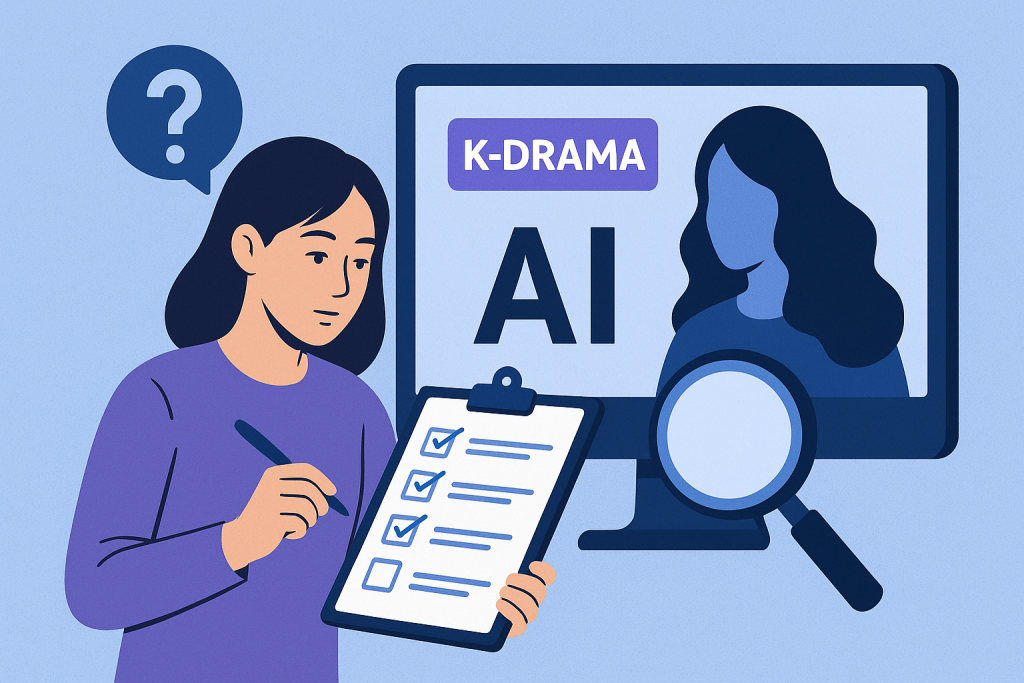
Use a repeatable checklist so you’re not relying on vibes.
- Temporal consistency: does the face alignment stay stable across multiple frames, or does it “swim” during fast motion?
- Lighting and skin tone coherence: do highlights and shadows match the scene’s direction and intensity?
- Edge behavior: do hairlines, eyebrows, and ear contours show jagged transitions?
- Motion alignment: do lip shapes and facial micro-movements track naturally with speech?
- Background interaction: does the face composite respect occlusions (hands, collars, microphones)?
Common mistake: judging only one frame. Artifacts often appear intermittently. Review multiple moments around the rumor’s claimed “AI cast” segment.
How to document your review so others can verify it
If you want your research to be credible, capture evidence in a structured way. Don’t just say “it looks off.” Record what you observed and where.
- Note the episode number and timestamp range.
- Write down 2-4 specific artifact types you observed (lighting mismatch, edge wobble, occlusion errors).
- Save the original clip source URL and the upload date.
This approach makes it easier to compare with other reports and reduces confirmation bias.
Reverse image search for screenshots: useful, but not a smoking gun
People often jump straight to reverse image search for screenshots. It’s a strong tool for detecting reuse, but it cannot prove that a particular clip is an AI cast replacement.
What reverse image search can tell you
- Whether a screenshot appears in unrelated contexts (older posts, different shows, different languages).
- Whether the same image was used as a thumbnail or meme before the rumor started.
- Whether the “evidence” is actually a reused still from another production.
What reverse image search cannot tell you
- Whether the current clip was edited by someone using actor likeness misuse.
- Whether any AI generation occurred in the specific episode you’re investigating.
- Whether the rumor’s timeline is accurate.
Practical tip: when you search, try multiple crops (face-only, wider shot, and background objects). Crops that include unique set elements often return better matches.
Fast research workflow (10-20 minutes) for K-drama rumors
If you want speed, you need an order. Here’s a fast workflow that prioritizes verifiable signals first, then uses visual checks as support.
1) Identify the exact claim and the exact episode
Write down what the rumor says: “AI replaced Actor X with Actor Y,” or “the cast list is AI-generated,” or “a deepfake appears at timestamp T.” Then confirm the episode and timestamp range.
2) Verify credited cast names from official sources
Search for the episode title + broadcaster + production company. Then check whether the credited cast matches the rumor narrative.
If official credits contradict the rumor, you already have a strong reason to pause. If they don’t contradict it, proceed.
3) Check press release confirmation and distributor pages
Look for press release confirmation that mentions the cast or the production’s main promotional materials. If the rumor claims a replacement, the official materials usually reflect the real credited cast.
4) Do a scene artifact review on the specific segment
Use your checklist: temporal consistency, lighting coherence, edge behavior, motion alignment, and occlusion respect. Record 2-4 concrete observations.
5) Run reverse image search for screenshots (multiple crops)
Use screenshots from the same timestamp range. If you find the same face or frame reused elsewhere, that’s a strong lead for fan rumor debunking.
6) Triangulate with independent posts (not just one account)
Look for independent reviewers: people who cite timestamps and credits, not just reactions. The goal is source triangulation, not pile-ons.
Common mistakes that make AI cast rumors feel “true”
Rumors persist because they exploit predictable cognitive shortcuts. Avoid these traps.
Mistake 1: Treating a single clip as proof
A clip can be edited, compressed, or misattributed. Even a real deepfake can be unrelated to the specific episode being discussed.
Mistake 2: Ignoring production company credits
If you skip credits, you lose the highest-reliability evidence. Always check official cast listings first.
Mistake 3: Confusing “AI involvement” with “AI cast replacement”
Some productions use AI for subtitles, color correction, or VFX cleanup. That is not the same as an AI cast claim.
Mistake 4: Over-weighting “it looks wrong”
Visual artifacts can come from compression, low light, or camera motion. Use artifact review as supporting evidence, not a standalone verdict.
How to research responsibly (and protect privacy)
When rumors involve real people, the risk isn’t only misinformation. It’s also privacy harm and further spread of potentially manipulated content.
Use a privacy-first approach
- Avoid downloading and re-uploading clips that may involve actor likeness misuse.
- If you share, link to the original source and include timestamps rather than reposting full-resolution face crops.
- Be careful with comments that identify individuals as “the AI” without evidence.
If you want a practical safety checklist for fans who encounter deepfake content, you can review Celebrities & AI Deepfakes: A Practical Privacy Checklist for Fans Who Download or Share Clips.
When the rumor is likely true vs likely false
You can’t always reach certainty. But you can reach a reasoned assessment based on evidence quality.
Likely true (stronger confidence)
- Official credits and production company credits align with the rumor’s claimed cast change.
- Multiple independent sources reference the same timestamp and cite documentation.
- Scene artifact review shows consistent issues across multiple moments, not just one frame.
Likely false (stronger confidence)
- Official cast credits contradict the rumor.
- Reverse image search finds the screenshot reused from another show, time, or context.
- The rumor relies on vague claims without timestamps or episode identification.
Unclear (you should pause sharing)
- Credits are ambiguous or region-dependent.
- Artifacts are explainable by compression or editing quality.
- Only one account claims the AI cast replacement without corroboration.
Checklist: your “evidence matters” template for K-drama deepfake rumors
Copy this into your notes before you post or share anything.
- Claim: What exactly is alleged (AI replaced Actor X with Actor Y, or AI generated cast list)?
- Episode + timestamp: Where does it allegedly occur?
- Press release confirmation: Is there official confirmation or denial?
- Production company credits: Do end titles and platform metadata match the claim?
- Scene artifact review: Which 2-4 artifacts do you observe, and where?
- Reverse image search for screenshots: Do screenshots appear in unrelated contexts?
- Source triangulation: Do independent sources agree with the same evidence?
If you can’t fill at least three of these items with reliable sources, treat the rumor as unverified.
Bonus: how to keep your “tech-curious” research from turning into misinformation
Tech curiosity is a strength when it’s paired with verification habits. The fastest way to become reliable is to separate “interesting” from “confirmed.”
If your curiosity also touches adjacent AI entertainment topics, you may find it helpful to compare verification patterns across media. For example, Hollywood vs Anime Crossover Hype: How to Verify Real Production vs Marketing Smoke offers a similar triangulation mindset for hype-heavy claims.
Key takeaways
- Start with casting verification via official credits and press release confirmation.
- Use scene artifact review and reverse image search for screenshots as supporting evidence, not proof alone.
- Apply source triangulation to avoid being trapped by one viral post.
- Be privacy-aware when content may involve actor likeness misuse.