AI-Enhanced Subtitles for K-Dramas: The Real Goal (Meaning, Not “Fluency”)
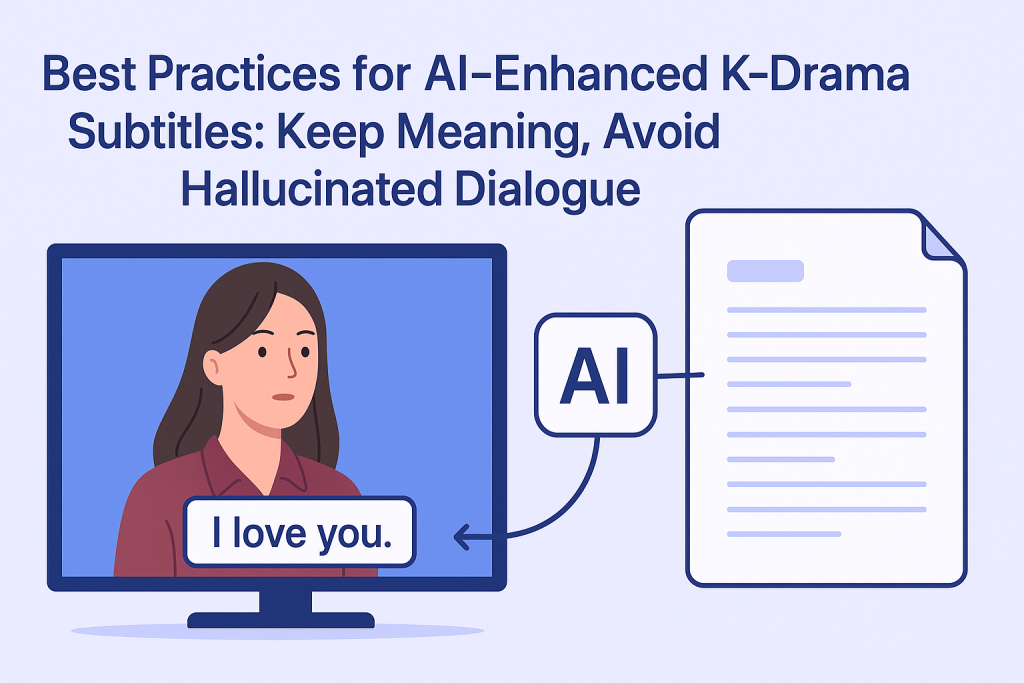
AI subtitle enhancement can make K-dramas easier to follow, but it also introduces a specific failure mode: hallucinated translation. That’s when the subtitle becomes “more readable” while drifting away from what was actually said.
For K-drama viewers who want accurate dialogue, the winning approach is subtitle quality control built around glossary constraints, terminology consistency, speaker labeling accuracy, and timing drift correction-then backed by a human-in-the-loop review.
What “hallucinated translation” looks like in K-drama subtitles
Hallucinated translation usually shows up as one of these patterns. The subtitle sounds plausible, but it changes intent, tone, or factual content.
- Meaning drift: a character’s refusal becomes a suggestion, or a threat becomes a joke.
- Context substitution: an AI replaces a vague line with a more specific one that never appears in the audio.
- Character intent inversion: politeness markers flip (e.g., “I’m sorry” becomes “I’m fine”).
- Speaker confusion: the subtitle shows the wrong line under the wrong speaker label.
Start With Constraints: The Subtitles Are a Translation, Not a Rewrite
AI systems often optimize for readability. Your job is to constrain the output so it preserves meaning and stays aligned with the source audio and on-screen context.
Think of this as glossary constraints and terminology consistency for subtitles, not general translation. K-dramas include recurring character names, honorifics, slang, and relationship terms that must remain stable across episodes.
Build a glossary that matches how K-dramas actually speak
Before you enhance subtitles, create or import a glossary tailored to the show. Include terms that viewers notice immediately when they change.
- Character names: choose one spelling and stick to it across the entire run.
- Honorifics: decide how you handle -ssi, -nim, and -ahjussi style forms.
- Relationship terms: lock in translations for “older sibling,” “aunt/uncle,” “friend,” and romantic address terms.
- Recurring phrases: slogans, catchphrases, and repeated insults.
- Proper nouns: school names, neighborhoods, companies, and locations.
When you enforce glossary constraints, you reduce the chance that the model “improves” a line by swapping in a synonym that changes tone.
Enforce terminology consistency across episodes
Terminology consistency is not just aesthetics; it’s comprehension. If a character is called “Manager Park” in one scene and “Mr. Park” in another, viewers may lose track of who is who.
Use a show-level terminology map and apply it during AI subtitle enhancement. Then run subtitle quality control checks that compare earlier and later occurrences for stability.
Get Speaker Labeling Accuracy Right Before You Polish
Speaker labeling accuracy is a common weak point in automated subtitle pipelines. If the speaker attribution is wrong, even perfect translation will read like a different scene.
In K-dramas, speaker changes often happen quickly, with overlapping dialogue and emotional shifts. Your workflow should treat speaker assignment as a first-class problem.
Practical checks for speaker labeling accuracy
- Cross-check subtitles against mouth movement and cut timing.
- Verify that dialogue tags match the character who appears on screen.
- Watch for rapid turn-taking where AI tends to “merge” lines.
- Confirm honorific usage aligns with the relationship shown visually.
If your pipeline supports it, keep speaker labels separate from the translated text. That separation makes it easier to correct attribution without re-translating everything.
Fix Timing Drift Correction Early (Before Meaning Edits)
Timing drift correction matters because subtitles that arrive late or early force viewers to guess. When viewers guess, they interpret the line differently than intended.
AI subtitle enhancement often includes re-segmentation. That can shift start/end times, especially when the model changes sentence structure.
How timing drift happens in subtitle enhancement
- Reflowing text: longer translations push timing boundaries.
- Segment mismatch: the AI aligns to the wrong audio chunk.
- Silence handling: models may compress pauses, shrinking subtitle duration.
- Line splitting: the system changes where it breaks lines, affecting perceived rhythm.
Timing drift correction workflow that works
- Lock the original segmentation as the baseline wherever possible.
- Apply timing adjustments only after translation is constrained by glossary constraints and terminology consistency.
- Re-check subtitle readability: each subtitle should fit the intended display duration without forcing viewers to “read ahead.”
- Spot-check scenes with fast dialogue and emotional pauses, since these are where drift becomes most noticeable.
This order-constrain meaning first, then correct timing-reduces rework in your post-edit workflow.
Use a Post-Edit Workflow That Prevents Hallucinated Translation
A reliable post-edit workflow is where most quality gains come from. The goal is to catch hallucinated translation before it ships to viewers.
Use a human-in-the-loop review approach: the AI drafts, and a reviewer verifies meaning, speaker labeling accuracy, and terminology consistency.
Design your post-edit workflow around “failure modes”
Instead of reading every subtitle from scratch, review by risk. Hallucinated translation tends to cluster in certain situations.
- Ambiguous pronouns: “he/she/that” lines where the AI picks the wrong referent.
- Honorific-heavy dialogue: where tone depends on -ssi/-nim usage.
- Idioms and slang: where the AI replaces an idiom with a literal phrase.
- Emotional reversals: sarcasm, teasing, and anger disguised as politeness.
- Overlapping speech: where speaker labeling accuracy breaks down.
Human-in-the-loop review checklist (fast but effective)
- Meaning: does the subtitle preserve intent (refuse/agree/threaten/comfort)?
- Speaker: does the subtitle belong to the on-screen character?
- Terminology: are names, honorifics, and key terms consistent?
- Timing: does the subtitle appear long enough to be read comfortably?
- Terminology consistency: does the same term remain stable across the scene?
When you follow this checklist, you catch hallucinated translation without turning every episode into a full-time job.
Search Modifiers Matter: How Viewers Actually Find “Good Subtitles”
Many readers search for “subtitles K-drama” and then add modifiers like “accurate,” “translation,” “AI,” or “glossary.” Your subtitle quality control strategy should reflect what viewers are trying to solve.
If your content or tooling is discoverable, include language that signals reliability: “AI subtitle enhancement with glossary constraints,” “hallucinated translation prevention,” and “speaker labeling accuracy checks.”
What to emphasize in your subtitle QA documentation
- Subtitles accuracy goals (meaning preservation).
- Subtitle quality control steps (human-in-the-loop review).
- Timing drift correction approach (when and how you adjust).
- Terminology consistency rules (how you lock names/honorifics).
- Glossary constraints coverage (what’s included).
This helps tech-curious adults and pop-culture fans trust the output before they even press play.
Common Mistakes That Create “Confidently Wrong” Subtitles
AI can be dangerously persuasive. It may produce grammatically correct subtitles that still violate meaning. Here are the mistakes I see most often when teams adopt AI subtitle enhancement without guardrails.
Top mistakes to avoid
- Over-permissive rewriting: asking the model to “make it sound natural” without glossary constraints.
- No speaker verification: translating text while ignoring speaker labeling accuracy.
- Skipping timing drift correction: letting re-segmentation change rhythm and comprehension.
- One-off terminology: translating names differently across episodes.
- Editing without a post-edit workflow: “fixing” lines ad hoc instead of using a consistent review checklist.
If you fix only grammar and ignore meaning, you increase the odds of hallucinated translation.
Implementation Blueprint: A Practical Pipeline for AI-Enhanced Subtitles
Below is a production-minded pipeline you can adapt for K-drama subtitle enhancement. It’s designed to keep meaning intact and reduce hallucinated translation.
Pipeline steps (meaning-first)
- Ingest the audio-aligned subtitle file as the baseline.
- Apply glossary constraints and terminology consistency rules during translation.
- Preserve speaker labeling accuracy by keeping attribution separate from translated text.
- Run timing drift correction after translation, not before.
- Perform subtitle quality control using a human-in-the-loop review checklist.
- Export final subtitles with consistent terminology and stable segmentation.
Quality gates that catch hallucinated translation
Use gates that are quick to check and hard to “accidentally pass.”
- Glossary gate: every key term must match the glossary constraints.
- Speaker gate: every line must match the on-screen speaker.
- Meaning gate: reviewers confirm intent (refuse/agree/threaten/comfort).
- Timing gate: subtitles must be readable within their display windows.
These gates reduce the chance that AI produces fluent but incorrect dialogue.
Related Risks: When Subtitle Work Intersects Celebrity Content
K-dramas often circulate alongside celebrity clips and fan edits. If your subtitle enhancement workflow includes sharing or republishing clips, be mindful of privacy and misuse risks.
If you’re also dealing with celebrity-related media, review a privacy checklist for fans who download or share clips: Celebrities & AI Deepfakes: A Practical Privacy Checklist for Fans Who Download or Share Clips.
Key Takeaways Checklist
- Use glossary constraints and terminology consistency to prevent meaning drift.
- Verify speaker labeling accuracy before polishing dialogue.
- Apply timing drift correction after translation to avoid rhythm breakage.
- Run subtitle quality control with a human-in-the-loop review.
- Target hallucinated translation failure modes: idioms, pronouns, honorific tone, and overlapping speech.
If you implement these practices, AI subtitle enhancement becomes a reliable assist for K-drama viewers-not a generator of confidently wrong dialogue.